
Summer Commercial Tile & Grout Cleaning Cedarhurst, NY

By Josh Kaplan
Key Takeaways
Summer foot traffic accelerates grout soiling — schedule professional cleaning before peak season, not after.
Surface area, material type, and grout condition are the biggest cost drivers for commercial jobs.
Truck-mounted hot-water extraction outperforms portable machines on large commercial floors.
Professionally cleaned and sealed grout typically stays cleaner far longer than unsealed grout.
Ask every contractor whether sealing, grout repair, and a post-clean inspection are included in the quote.
Summer Commercial Tile and Grout Cleaning in Cedarhurst, NY: What Every Business Owner Should Know
Summer commercial tile and grout cleaning is the process of deep-cleaning high-traffic tile surfaces in business settings before and during the warmer months, when foot traffic, humidity, and outdoor contaminants peak. For Cedarhurst, NY businesses — from retail storefronts on Central Avenue to restaurant dining rooms near the Five Towns corridor — summer is precisely the season that exposes every neglected grout line. Scheduling a professional clean at the right time protects your surfaces, your brand image, and your long-term flooring investment. For a broader look at how this fits into overall surface care, the commercial tile and grout cleaning guide for Long Island covers the full regional picture.
Why Summer Is the Critical Season for Commercial Tile in Cedarhurst
Cedarhurst sits in Nassau County, where July and August bring genuine coastal humidity from nearby waterways like Hewlett Harbor and the broader South Shore. That humidity matters for tile and grout in a very specific way: moisture drives mold and mildew into unsealed or worn grout lines faster than in dry climates, and sand tracked in from nearby beaches becomes an abrasive that accelerates grout erosion at an accelerated pace compared with winter months.
Summer also means increased customer volume. A restaurant that seats 60 covers at dinner in January may seat 90 in July as outdoor dining spills back inside and local foot traffic rises. More covers mean more spills, more cleaning product residue, and more grout discoloration — all within a compressed window. Businesses that wait until September to address the problem are dealing with months of compacted soiling rather than routine seasonal buildup.
There is also a scheduling advantage to acting early. Professional tile and grout cleaning services are easier to book in May or early June than in August, when commercial clients across the Five Towns — from Island Park eateries to Hewlett Bay Park office buildings — are all competing for the same appointment slots.
What Do Professionals Clean Tile and Grout With?
Professional tile and grout cleaners use a combination of pH-balanced alkaline detergents, high-pressure hot water, and mechanical agitation — most effectively delivered through truck-mounted extraction systems. The truck-mounted unit is the industry benchmark for large commercial floors: it heats water to temperatures that dissolve grease and biofilm far more completely than any portable machine, then extracts the dirty water immediately so it does not re-contaminate the surface.
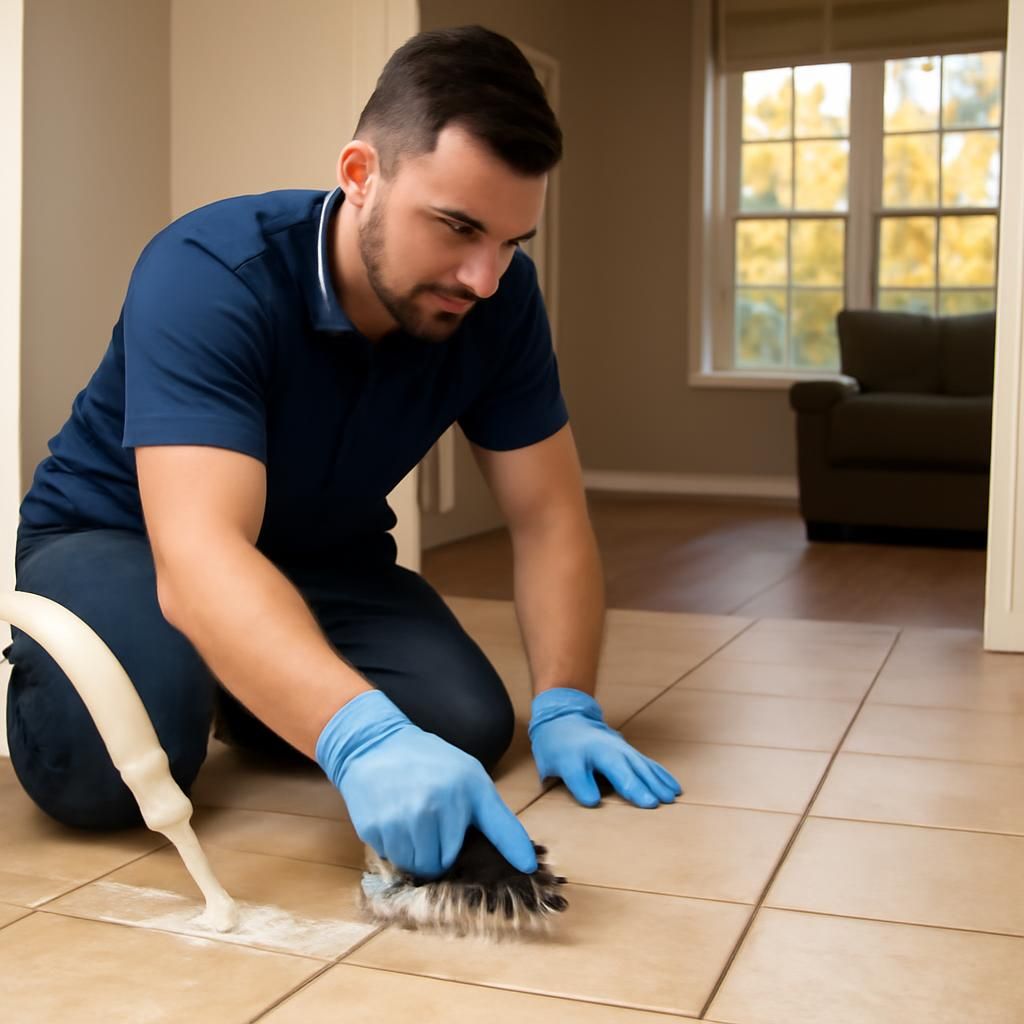
For particularly stubborn staining — burnt-in kitchen grease in a restaurant, for example — professionals typically pre-treat grout lines with a concentrated alkaline dwell solution, allow it to penetrate for several minutes, then agitate with a stiff-bristle rotary brush before extraction. On natural stone tile (marble, travertine, limestone), the chemistry shifts: acidic cleaners are never used because they etch the surface, so pH-neutral formulas are substituted. This distinction between ceramic/porcelain protocols and natural stone protocols is one of the most practically important things to confirm when hiring a contractor — and it's covered in detail in this guide to natural stone vs. tile sealing key differences.
What Is the Best Commercial Tile and Grout Cleaning Machine?
For large commercial jobs, truck-mounted hot-water extraction systems — such as those built on platforms like the Prochem Peak or equivalent commercial-grade units — consistently outperform portable extractors because they sustain higher water temperatures and stronger vacuum pressure across continuous use. Portable steam machines are adequate for maintenance cleaning of small areas but lose pressure efficiency over a 2,000-square-foot commercial floor. The key differentiator is sustained heat: grease and biofilm in grout pores require consistent high-temperature exposure to fully release, which a portable unit cannot maintain over a large job.
A second tool worth asking your contractor about is a rotary surface cleaner attachment — a spinning pressurized head that cleans tile and grout in consistent overlapping passes rather than a wand that an operator manually drags. On large, uniform commercial floors, a rotary head produces more even results and reduces the risk of missed strips.
How Often Should Commercial Tile and Grout Be Professionally Cleaned?
Commercial tile and grout in high-traffic environments — restaurants, retail, healthcare, gym facilities — generally benefits from professional deep cleaning every six to twelve months, with many food-service operators scheduling twice annually: once before summer peak season and once before the winter holiday rush. Light-traffic commercial spaces like professional offices can often extend to an annual cycle. Sealed grout extends the interval between professional cleans because it resists soiling at the pore level; unsealed grout may need attention more frequently. These intervals are guidelines, not rules — the right schedule depends on your specific floor, traffic load, and daily maintenance routine.
Is Professional Tile and Grout Cleaning Worth It for a Commercial Space?
Yes — for most commercial settings, professional tile and grout cleaning delivers measurable value that consumer-grade cleaning cannot replicate. The core reason is penetration depth: commercial grout is porous, and daily mopping drives soils deeper into the grout line rather than removing them. Over time, that compacted soil becomes discolored, harbors bacteria, and cannot be reversed with surface-level cleaning alone. A truck-mounted professional system extracts soil from within the pore, restoring the original grout color rather than just lightening the surface temporarily.
There is also a durability argument. Grout that is cleaned and then sealed professionally resists re-soiling significantly longer than bare grout — meaning the interval before the next professional service extends, which changes the cost-per-year calculation substantially. For a Cedarhurst restaurant or retail space where tile appearance directly affects customer perception, that durability argument is difficult to dismiss. Property managers overseeing multiple commercial spaces will find additional context in this guide to commercial tile and grout cleaning for Long Island property managers.
Does Dawn Dish Soap Clean Tile Grout?
Dawn dish soap — or any standard dish detergent — can lift light surface soiling from tile but is not effective for deep grout cleaning, and it carries a specific risk in commercial settings: surfactant residue. Dish soap leaves a thin film on grout surfaces that attracts dirt faster than a clean pore would, creating a cycle where the floor looks clean immediately after mopping but re-soils faster than before. For routine commercial maintenance between professional services, pH-neutral tile-specific cleaners are the correct choice — they rinse completely without leaving a residue layer.
How Long Does Professional Grout Cleaning Last?
Professionally cleaned and sealed grout in a commercial setting typically maintains its restored appearance for one to three years before another deep clean is warranted, depending on traffic volume and daily maintenance practices. Unsealed grout in a high-traffic restaurant may visibly re-soil within six months. The sealer is the critical variable: penetrating silicone-based or fluoropolymer sealers fill the grout pore and create a barrier against oils, water, and food particles — extending the clean dramatically. Always confirm whether sealing is included in a contractor's quote or priced separately.
What Drives the Cost of Commercial Tile and Grout Cleaning?
Understanding what professionals quote on — before you accept or compare bids — helps you evaluate proposals fairly. These are the genuine cost drivers for commercial jobs:
Total surface area: Larger floors take more time, more product, and more labor. A 500-square-foot café and a 3,000-square-foot supermarket are fundamentally different jobs.
Grout condition: Heavily stained or damaged grout requires longer dwell times, more aggressive pre-treatment, and potentially grout repair before cleaning — all adding to labor.
Tile and grout type: Natural stone requires specialized, pH-neutral chemistry and more careful handling than ceramic or porcelain. Epoxy grout responds differently than sanded cement grout. Material type affects both product cost and time.
Grout line width and layout: Wide grout lines in complex patterns (herringbone, mosaic) take longer to agitate and extract than straight-set large-format tiles with narrow grout joints.
Access difficulty: Built-in fixtures, heavy equipment, or restaurant booths that cannot be moved require working around obstacles — slower and therefore more expensive than an open floor plan.
Sealing: Grout sealing after cleaning is a separate process that adds time and material cost. Some contractors bundle it; many quote it separately. Always clarify.
Repair needs: Cracked, missing, or hollow grout must be repaired before sealing. Grout repair is typically quoted per linear foot or per area and should be itemized separately so you can compare it across bids.
How to Compare Commercial Cleaning Quotes Fairly
Not all tile and grout cleaning quotes describe the same scope of work. Before you accept a bid, confirm answers to these specific questions:
Is sealing included? A quote that omits sealing may look cheaper but leave your floor unprotected and re-soiling faster.
What equipment will be used? Truck-mounted or portable? The answer affects outcome quality on a large commercial floor.
What products are used on your specific tile type? A contractor who confirms they switch to pH-neutral chemistry for natural stone demonstrates real knowledge; one who gives a vague answer may not.
Is grout repair included or separate? Get it itemized so you understand the full scope.
What does the post-clean inspection cover? Will the contractor walk the floor with you before leaving and address any missed areas?
Are there any access requirements? Will you need to move furniture or close the space for a period? Factor that operational cost into your comparison.
For a detailed breakdown of what local services typically charge, the 2025 tile and grout cleaning cost guide for Long Island provides current pricing benchmarks you can use when evaluating bids.
Safety and Surface-Specific Warnings: What to Avoid
Several common cleaning mistakes cause real, sometimes irreversible damage to commercial tile surfaces — and they are specific enough to name:
Acidic cleaners on natural stone: Vinegar, lemon-based cleaners, and any product with a low pH etch marble and travertine permanently, creating dull spots that require professional re-honing to correct. Never apply these to natural stone tile.
Steam cleaning on certain resilient tiles: Prolonged high-heat steam directed at vinyl composite tile (VCT) or older adhesive-set tiles can soften the adhesive layer beneath, causing tiles to loosen or warp.
Wire brushes on colored grout: Mechanical wire or metal-bristle brushes abrade colored grout pigment, creating paler streaks that cannot be restored without re-grouting.
Sealing dirty grout: Applying a penetrating sealer over grout that has not been deep-cleaned locks the existing soils into the pore permanently — the grout will look clean on the surface briefly, then discolor from within. Always clean before sealing.
Oxygen bleach on colored grout without testing: Oxygen-based cleaners can lighten pigmented grout colors unevenly. Test a hidden area first.
When to Call a Professional Instead of Handling It In-House
In-house clean
This article is based on real published content from Groutastic, cites authoritative sources, and is reviewed before publication.
Comments