
Porcelain Tile Cleaning & Restoration: Long Island Guide

By Groutastic
Key Takeaways
Porcelain tile is dense and low-maintenance, but grout lines still trap dirt and require regular deep cleaning.
pH-neutral cleaners protect porcelain's glaze; acidic or bleach-based products cause permanent surface damage.
Grout recoloring or replacement restores appearance when cleaning alone can't remove deep staining.
Long Island's hard water leaves mineral deposits on tile that require targeted descaling, not standard mopping.
Professional restoration costs $0.50–$3 per sq ft; DIY saves money but misses grout repair and resealing.
What Is Porcelain Tile Cleaning and Restoration — and Why Does It Matter on Long Island?
Porcelain tile cleaning and restoration is the process of removing embedded dirt, stains, and mineral deposits from porcelain surfaces, then repairing or resealing grout and caulk to return tile to its original condition. On Long Island, where hard municipal water accelerates mineral buildup and coastal humidity promotes mold growth in grout joints, routine maintenance alone is rarely enough to keep porcelain floors and showers looking new.
Porcelain is one of the most durable flooring materials available — fired at temperatures above 2,200°F, it absorbs less than 0.5% moisture according to The Tile Shop. That density makes it stain-resistant on the tile face itself, but the grout lines surrounding each tile are porous cement that traps grease, soap scum, and hard-water scale. Over time, even the cleanest-looking porcelain floor can look dingy because of discolored grout — not the tile itself.
How Does Long Island's Water Quality Affect Porcelain Tile?
Long Island's water supply is drawn from the Nassau and Suffolk County aquifer systems, which carry elevated levels of calcium and magnesium. These minerals leave white or grey deposits — commonly called hard-water scale or limescale — on tile surfaces and inside grout pores every time water evaporates. In showers, the combination of soap residue and limescale creates a chalky film that ordinary mopping cannot dissolve.
The practical effect is a two-part problem: the tile face needs descaling with a pH-neutral or mildly acidic product, while the grout needs a dedicated alkaline cleaner to cut through organic buildup. Using the wrong product on the wrong surface can etch the glaze on polished porcelain or weaken grout mortar — either outcome accelerates deterioration rather than reversing it.
Signs Your Long Island Porcelain Tile Needs Restoration
Grout lines darker than their original color — usually black, grey, or brown from mold, mildew, or ground-in dirt.
White or chalky haze on tile faces — hard-water mineral deposits or efflorescence rising through grout.
Cracked, crumbling, or missing grout — structural damage that allows water to migrate behind tile.
Peeling or moldy caulk in shower corners — a moisture entry point and a health concern.
Dull or scratched tile surface — finish degradation on polished or semi-polished porcelain.
Persistent musty odor — mold colonizing grout below the surface.
Step-by-Step: How to Clean Porcelain Tile the Right Way
Cleaning porcelain tile correctly depends on the finish — polished, matte, or textured — and the type of soil present. The steps below cover a thorough deep-clean suitable for Long Island kitchens, bathrooms, and shower enclosures. For a closer look at what this process involves when you hire a pro, see our guide to grout cleaning service on Long Island and what to expect.
Sweep or vacuum first. Remove all loose debris before introducing any liquid. Grit dragged across porcelain during wet cleaning causes micro-scratches on glazed surfaces.
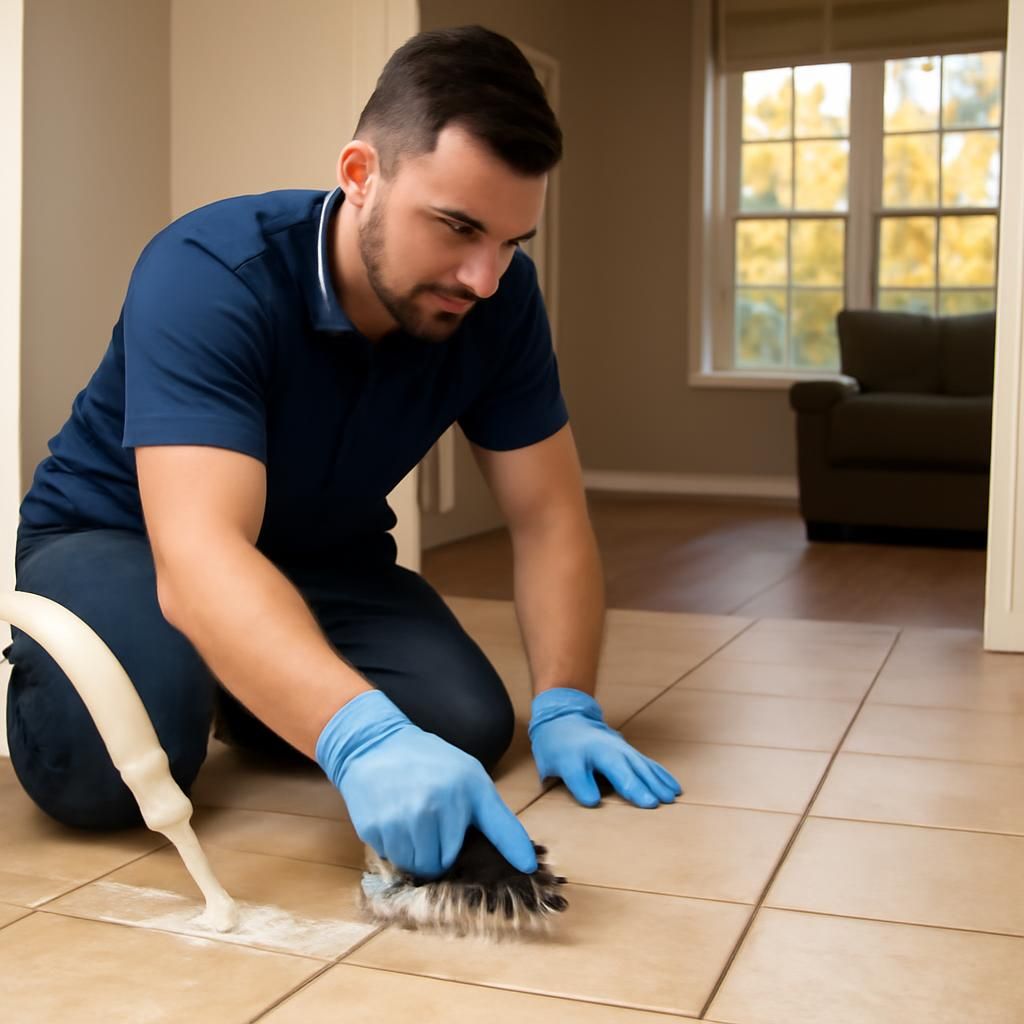
Pre-treat grout lines. Apply an alkaline grout cleaner (pH 9–11) directly to grout joints and let it dwell for 5–10 minutes. This breaks down organic matter before scrubbing.
Scrub grout with a stiff nylon brush. Never use a wire or metal brush — metal bristles leave rust deposits in porous grout. Work in short strokes along the joint, not across it.
Clean the tile face with a pH-neutral cleaner. Dilute per the manufacturer's instructions, mop or wipe the tile surface, and avoid letting solution pool in grout joints longer than necessary.
Address mineral deposits separately. For hard-water scale on tile faces, apply a specially formulated calcium/lime remover with a pH of 4–6, dwell for 2–3 minutes, then scrub gently. Never use undiluted white vinegar on grout — the acidity degrades cement-based mortar.
Rinse thoroughly with clean water. Cleaner residue left on the surface attracts new soil faster. Two rinse passes are standard practice.
Dry completely. In humid Long Island bathrooms, use a squeegee and leave ventilation running for at least 30 minutes. Residual moisture trapped under grout sealant causes bubbling and premature failure.
What Products Are Safe — and Unsafe — for Porcelain Tile?
As noted by Bob Vila, porcelain and ceramic tiles look similar but porcelain's denser body makes it less forgiving of harsh chemicals — any product that penetrates the glaze reaches the fired body and can cause irreversible staining or etching. The table below summarizes safe and unsafe choices.
Product Type | Safe for Porcelain Tile? | Safe for Grout? | Notes |
pH-neutral floor cleaner | ✅ Yes | ✅ Yes | Best everyday option |
Alkaline degreaser (pH 9–11) | ✅ Yes (diluted) | ✅ Yes | Ideal for grout pre-treatment |
Calcium/lime remover (mild acid) | ✅ Yes (short dwell) | ⚠️ Limit exposure | Rinse quickly; avoid prolonged grout contact |
Undiluted white vinegar | ⚠️ Occasional use only | ❌ No | Erodes cement grout over time |
Bleach-based cleaners | ❌ No | ❌ No | Discolors grout permanently; damages sealants |
Abrasive scrub powders | ❌ No | ❌ No | Scratches glaze on polished porcelain |
Steam cleaner (no chemicals) | ✅ Yes | ✅ Yes | Excellent for sanitizing without chemicals |
Grout Repair and Recoloring: When Cleaning Is Not Enough
Deep cleaning removes surface and near-surface contamination, but it cannot fix structurally compromised grout or restore color to grout that has been permanently stained or bleached. At this point, grout repair or recoloring becomes necessary — and this is one of the most impactful restoration services for Long Island homeowners. If you're unsure whether your grout can be saved or needs to come out entirely, our breakdown of whether to regrout or replace tile walks through exactly how to make that call.
Grout Recoloring
Grout recoloring involves applying a pigmented, penetrating colorant over existing grout joints. It is appropriate when the grout is structurally intact but discolored beyond what cleaning can reverse. The result is a uniform, sealed finish in any chosen color — a popular upgrade in older Long Island homes where original beige grout has turned brown.
Grout Replacement (Regrouting)
When grout is cracked, crumbling, or missing entirely, regrouting is the correct solution. A technician removes the damaged grout to a depth of at least 3mm, cleans the joint, and packs in fresh grout. This is critical in showers and wet areas where compromised grout allows water infiltration behind tile — a leading cause of subfloor rot and mold damage in Long Island bathrooms.
Shower Caulk Replacement
Caulk — not grout — belongs in every interior corner of a tiled shower, at the tub-tile transition, and around fixtures. Grout in these locations cracks within months because the substrate flexes. Old or moldy shower caulk should be fully removed and replaced with mold-resistant silicone caulk rated for wet areas. For Long Island homeowners dealing with this specific issue, our complete guide to shower tile restoration on Long Island covers caulk replacement alongside every other step of the process. Groutastic provides dedicated shower caulking services for Long Island bathrooms where this detail is commonly neglected during DIY tile work.
What Does Professional Porcelain Tile Restoration Cost on Long Island?
According to Angi, professional tile and grout cleaning typically costs between $0.50 and $3.00 per square foot nationally, with full restoration services — including grout repair, recoloring, and sealing — running toward the higher end of that range or beyond in high-cost-of-living markets like Nassau and Suffolk County. A standard 100-square-foot bathroom on Long Island can expect a professional restoration quote in the range of $250–$500 depending on tile condition and scope of work.
DIY cleaning costs are much lower in materials — typically $30–$80 for cleaners, brushes, and sealant — but the trade-off is labor time, equipment limitations (professional truck-mounted steam extraction systems reach temperatures no consumer steamer can match), and the risk of missing cracked grout or failing caulk that a trained eye would catch immediately.
Frequently Asked Questions: Porcelain Tile Cleaning on Long Island
How often should porcelain tile be professionally cleaned?
For high-traffic areas like kitchen floors or family bathrooms, a professional deep clean every 12–18 months is recommended. Shower enclosures used daily may benefit from professional service every 12 months given Long Island's hard water conditions.
Can I use a steam mop on porcelain tile?
Yes — a steam mop is one of the safest tools for porcelain tile because it sanitizes without chemicals. However, avoid prolonged steam contact on grout that has not been recently sealed, as repeated steam exposure can gradually loosen grout mortar over time.
Why do my porcelain tiles look hazy after mopping?
Haze after mopping is almost always caused by one of two things: cleaner residue left from insufficient rinsing, or hard-water mineral film deposited by tap water as it evaporates. Use a dedicated hard-water rinse aid or squeegee the floor dry immediately after mopping.
Is grout sealing necessary for porcelain tile?
Yes. Porcelain tile itself does not require sealing, but the cement-based grout surrounding it is porous and will absorb stains and moisture without a penetrating sealant. Sealant should be reapplied every 1–2 years in wet areas and every 2–3 years on dry floors. To choose the right product for your bathroom, see our guide to the best grout sealers for bathrooms.
What is the difference between grout cleaning and grout restoration?
Grout cleaning removes surface soil and near-surface contamination using chemical and mechanical agitation. Grout restoration encompasses cleaning plus structural repair (regrouting cracked joints), color correction (recoloring), and protective sealing — a complete return to original or improved condition.
Conclusion: Restore Your Long Island Porcelain Tile the Right Way
Porcelain tile cleaning and restoration is not a one-size-fits-all task — it requires matching the right cleaner to the right surface, addressing grout and caulk as separate materials with separate needs, and accounting for Long Island-specific challenges like hard water and coastal humidity. Whether you are tackling a kitchen floor with surface grime or a shower enclosing years of soap scum and mold, the best outcome comes from a systematic approach: clean first, repair second, seal last.
Groutastic serves Long Island homeowners with professional tile cleaning, grout repair, grout recoloring, and shower caulking services designed to restore porcelain tile to its original condition — or better. If your tile looks dull, your grout is discolored, or your shower caulk is peeling, contact Groutastic for a free assessment and quote. Professional restoration costs far less than tile replacement and delivers results that no off-the-shelf cleaner can match.
This article is based on real published content from Groutastic, cites authoritative sources, and is reviewed before publication.
Comments